Vinyl acetate monomer (VAM) is a widely used industrial chemical, the building block for the vinyl acetate polymers found in adhesives, paints, coatings, fillers, plasters, and primers. People can be exposed by inhalation, which is the primary route, as well as orally or dermally. Once absorbed, VAM is broken down very quickly by carboxylesterases into acetic acid and vinyl alcohol, and then acetaldehyde, with half-lives measured in seconds to minutes, so little of the parent chemical reaches tissues beyond the point of first contact. In animal studies, tumors appear mainly at those points of contact, the nose after inhalation and the upper gastrointestinal tract after oral exposure. Because California’s Carcinogen Identification Committee placed VAM on the Proposition 65 list, a No-Significant-Risk-Level (NSRL) value is needed, and how that value is derived depends heavily on how VAM causes cancer.
To inform that question, SciPinion convened an independent panel of five experts in cancer mode of action (MOA), dose-response assessment, and risk assessment, charged with weighing the evidence and advising on the key decisions behind an NSRL that reflects best available science. The panelists held doctoral degrees and averaged 43 years of experience. The review ran as a five-round modified Delphi, with panelists answering independently in rounds one, three, and five and debating one another’s answers in rounds two and four.
The review followed SciPinion’s triple-blinded process. The sponsor was blinded to the panelists, the panelists were blinded to the sponsor, and the panelists were blinded to one another (labeled only as “Expert 1,” “Expert 2,” and so on) until they reviewed the final manuscript, and every response and rationale was recorded and reported in full. The benchmark-dose modeling was carried out by analysts who were themselves blinded to both the sponsor and the identity of the chemical, with the underlying dose-response data anonymized.
On mechanism, the panel concluded that a cancer MOA driven by cytotoxicity and regenerative cell proliferation was best supported by the weight of evidence, with a mean score of +3.8 on a scale of -5 to +5. A MOA involving direct genotoxicity was clearly not supported, with a mean score of -3.6. Although VAM’s metabolite acetaldehyde can form DNA adducts, the panel judged that pathway to play only a minimal role compared with the primary cytotoxic mechanism, a pattern consistent with a nonlinear, threshold dose-response rather than a linear one.
The panel also expressed a strong preference for basing the NSRL on effects observed at the point of contact rather than on systemic tumors, none of which it considered useful for quantitative risk assessment. Because VAM is metabolized so rapidly at the site of contact, meaningful exposure of internal tissues to the parent compound is unlikely, and the point-of-contact effects are the scientifically relevant basis for the assessment.
Working through each decision point, the panel supported an inhalation NSRL of 20,000 μg/day, based on olfactory lesions in rats, and an oral NSRL of 110,000 μg/day, based on a rat drinking-water study. All five experts unanimously agreed with the inhalation value and placed high confidence in it, with a mean confidence score of 9.0 out of 10. Confidence in the oral value was medium, with a mean score of 6.4 out of 10, reflecting four of five panelists rating it high and one rating it low. Human exposures at or below these levels are not expected to pose a significant cancer risk.
The evaluation illustrates how mode-of-action evidence shapes a cancer risk value. Because the weight of evidence points to a threshold mechanism acting at the point of contact rather than to direct genotoxicity, a nonlinear extrapolation is scientifically appropriate, and the resulting NSRL values are considerably higher than a default low-dose linear calculation would yield. The authors conclude that, using best available science, human exposures to VAM at or below the derived inhalation and oral NSRLs are not expected to pose a significant cancer risk.
-
- Read the full paper here.
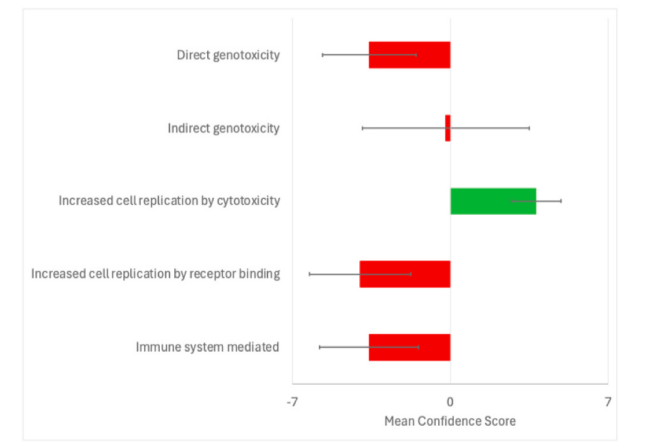
Figure 1. Panel confidence scores for the potential modes of action for the carcinogenicity of vinyl acetate monomer, rated on a scale from -5 (strongly opposed) to +5 (strongly supported).